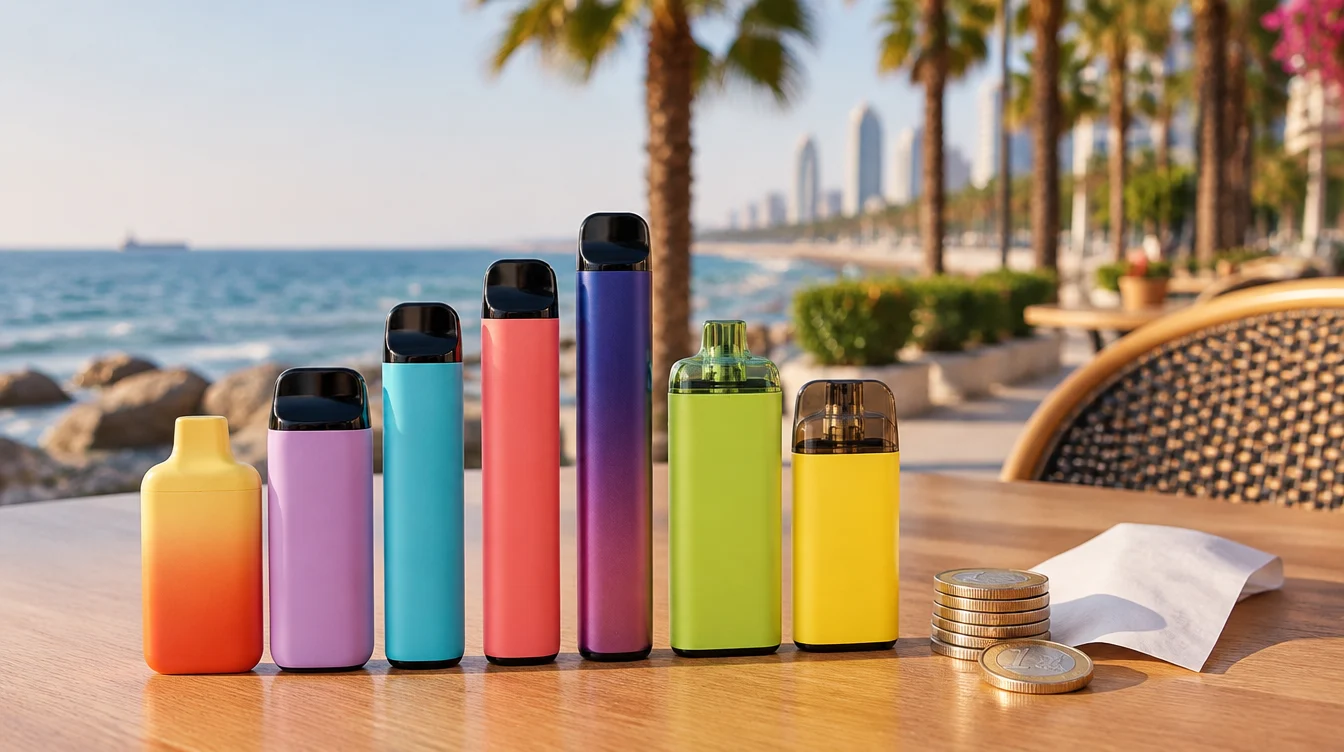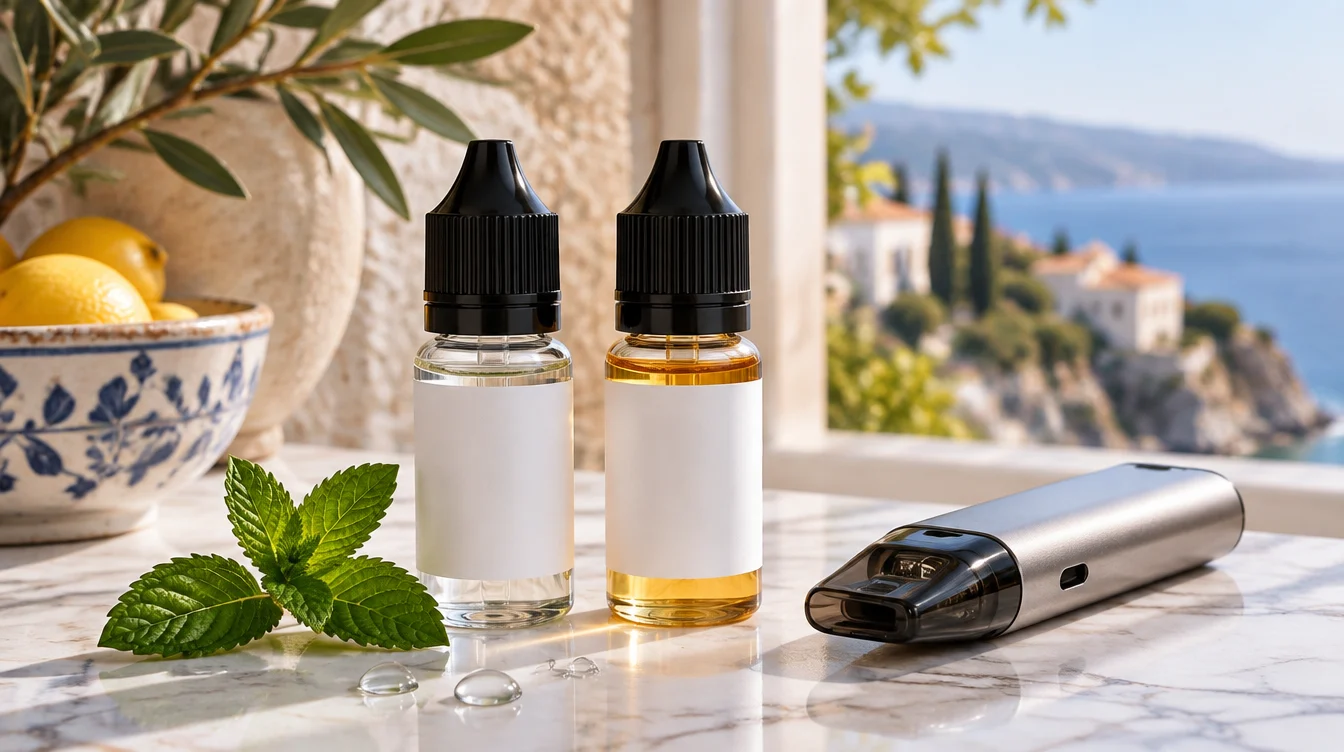
Nic salts and freebase e-liquids contain the same nicotine molecule. The difference is chemistry: nic salts add a mild acid that makes the vapour smoother, so higher strengths feel comfortable in a small pod kit. Freebase nicotine gives a stronger throat hit at the same strength and works best at low strengths in more powerful devices. This guide explains how each one works, what the research says and which one suits you.
The short answer
- Choose nic salts if you are switching from cigarettes, use a small pod kit or a disposable, and want a smooth draw at 10 to 20 mg/ml.
- Choose freebase if you use a sub-ohm tank or mod, want bigger clouds and prefer 3 to 6 mg/ml.
- At the same strength, freebase feels harsher than nic salt.
- Both are limited to 20 mg/ml and 10 ml bottles in Cyprus and the rest of the EU.
- Do not use 20 mg nic salt in a high-power sub-ohm device. You will take in far more nicotine than you intend.
In this guide
- What is the difference between nic salts and freebase?
- How nic salts work
- What the research says
- Nic salts vs freebase side by side
- Which devices suit each type
- Choosing the right strength
- Switching from cigarettes
- Freebase, shortfills and DIY mixing
- The rules in Cyprus
- Common mistakes
- Frequently asked questions
What is the difference between nic salts and freebase?
Nicotine exists in two chemical forms. In its freebase form it is unprotonated, more volatile and slightly alkaline. When an acid is added, nicotine becomes protonated, which is the salt form. Tobacco leaves naturally contain nicotine salts, and cigarette manufacturers have long used chemistry to control how much nicotine is in each form.
Early e-liquids used freebase nicotine. It works well at low strengths, but above about 12 mg/ml it becomes harsh on the throat. Nic salt e-liquids appeared around 2015 and solved that problem. By adding an acid, manufacturers made liquids at 20 mg/ml and higher that feel smooth enough to inhale comfortably from a small device.
In practice, the choice is less about the nicotine itself and more about how the vapour feels and which device you use.
How nic salts work
A nic salt e-liquid is made by combining nicotine with an organic acid. The most common acids are lactic acid, benzoic acid and levulinic acid. A laboratory study of 23 nic salt refill liquids by Harvanko and colleagues, published in Nicotine and Tobacco Research, found lactic acid in about 48 percent of samples, benzoic acid in about 35 percent and levulinic acid in about 17 percent.
The acid lowers the pH of the liquid. The same study measured an average pH of 4.9 in the nic salt liquids, close to the range of cigarette smoke. Most freebase liquids are alkaline and keep more than 60 percent of their nicotine in the freebase form.
Why does this matter? Freebase nicotine is more volatile and is what causes the sharp “throat hit”. Protonated nicotine is less irritating. That is why a 20 mg/ml nic salt can feel milder than a 12 mg/ml freebase liquid, even though it contains more nicotine.
What the research says
Most research on nic salts looks at three questions: how smooth they feel, how fast nicotine reaches the bloodstream and how much nicotine is delivered.
On smoothness, the chemistry is well understood and most vapers notice it straight away. Lower pH means less freebase nicotine in the vapour and less throat irritation.
On speed, a randomised cross-over study by O’Connell and colleagues, published in Internal and Emergency Medicine in 2019, tested nicotine lactate e-liquids in two pod devices against cigarettes in 15 adult smokers. The researchers found that the rate of nicotine absorption from all the e-cigarettes was comparable to a cigarette, while total nicotine delivery stayed below that of a cigarette.
On satisfaction, smokers in the same study rated the strongest nic salt product closest to their own cigarette, although all the e-cigarettes were rated as less satisfying than smoking.
Research on long-term effects of the different acids is still limited. Both forms are regulated in the same way in the EU, and both must meet the same ingredient and labelling rules.
Nic salts vs freebase side by side
| Nic salts | Freebase | |
|---|---|---|
| Throat hit | Smooth, even at 20 mg/ml | Stronger at the same strength |
| Typical strengths | 10 or 20 mg/ml | 3 to 12 mg/ml |
| Best devices | Pod kits, disposables, mouth-to-lung tanks | Sub-ohm tanks, mods, restricted lung pod kits |
| Typical VG/PG | 50/50 | 70/30 or higher VG |
| Vapour | Discreet | Larger clouds |
| Nicotine feel | Fast and close to a cigarette | Slower and gentler at low strengths |
| E-liquid use | Low, because devices run at low power | Higher, because devices run at higher power |
| Bottle size in the EU | 10 ml | 10 ml with nicotine, larger bottles nicotine-free |
Which devices suit each type
Nic salts are designed for low-power devices with a tighter, cigarette-like draw, known as mouth-to-lung vaping. You draw vapour into your mouth first and then inhale. Pod kits such as the UWELL Caliburn, Vaporesso XROS and VOOPOO Argus run at around 10 to 20 W with coils of about 0.6 to 1.2 ohm. Every disposable vape we sell also uses nic salt.
Freebase works best in devices that run at higher power with lower-resistance coils, usually below 0.5 ohm. These produce much more vapour per puff. If you used 20 mg nic salt in such a device, each puff would carry several times more nicotine than in a pod kit, which quickly becomes unpleasant. That is why sub-ohm vapers use freebase at 3 to 6 mg/ml. See our vape mods for this style of vaping.
Many modern pod kits sit in between. The VOOPOO Argus G4, UWELL Caliburn G4 and Vaporesso XROS 5 accept pods of different resistance and have adjustable airflow, so you can use nic salts with a 0.8 or 1.0 ohm pod and switch to a lower-strength liquid with a 0.4 ohm pod.
Choosing the right strength
A simple starting point based on how much you smoked or vape now:
| Your situation | Nic salt | Freebase |
|---|---|---|
| Smoked 15 or more cigarettes a day | 20 mg/ml | 12 mg/ml in a mouth-to-lung device |
| Smoked fewer than 15 a day | 10 to 20 mg/ml | 6 to 12 mg/ml |
| Already vaping and cutting down | 10 mg/ml | 3 to 6 mg/ml |
| Sub-ohm vaping for clouds | Not recommended | 3 mg/ml |
If the vapour makes you cough or feel light-headed, the strength is too high for your device. If you find yourself vaping constantly without feeling satisfied, it is probably too low. Our nic salts come in 10 and 20 mg/ml, so you can step down gradually.
Switching from cigarettes
For most smokers, a nic salt at 20 mg/ml in a simple pod kit or disposable is the most reliable way to switch. The draw feels familiar, the nicotine arrives quickly and the device fits in a pocket.
A few practical tips:
- Take slower, longer puffs than you would with a cigarette. Two to three seconds is enough.
- Expect a few days to adjust. The throat feel is different from smoke, even with nic salts.
- Keep a backup device or a spare bottle, so you are never tempted to buy cigarettes because you ran out.
- Once vaping feels natural, step down to 10 mg/ml if you want to reduce your nicotine intake.
Our guide to the best pod kit for beginners compares the kits that work best with nic salts.
Freebase, shortfills and DIY mixing
In Cyprus and the rest of the EU, any bottle that contains nicotine can hold no more than 10 ml. That is why larger bottles, such as aroma shots and shortfills, are sold without nicotine. You add nicotine yourself with a 10 ml booster.
A 60 ml bottle with a 12 ml aroma shot, topped up with base and one 10 ml booster at 18 to 20 mg/ml, gives roughly 3 mg/ml, a typical strength for freebase sub-ohm vaping. Two boosters give roughly 6 mg/ml. You can find everything for this in our e-liquids range, including aroma shots, bases and nicotine boosters.
DIY mixing makes sense if you vape a lot of liquid in a sub-ohm device. For a pod kit user who goes through 10 to 20 ml a week, ready-made nic salt bottles are simpler and give a more consistent result.
The rules in Cyprus
Both nic salts and freebase e-liquids fall under the EU Tobacco Products Directive. The main limits are the same for both:
- no more than 20 mg/ml nicotine
- no more than 10 ml in a bottle that contains nicotine
- no more than 2 ml in a tank, pod or disposable
- child-resistant and tamper-evident packaging with a health warning
Cyprus also charges an excise duty of €0.12 per ml on vape liquid, with or without nicotine. You can read more in our guides to vaping in Cyprus and disposable vape prices in Cyprus.
Common mistakes
- Putting 20 mg nic salt into a sub-ohm tank. The result is harsh vapour and far too much nicotine.
- Putting 3 mg freebase into a tight mouth-to-lung pod kit. It feels weak, so you end up vaping all day without satisfaction.
- Using high-VG liquid in a small pod. Thick liquid can struggle to soak the coil and cause dry, burnt hits.
- Judging strength by the number alone. A 20 mg nic salt and a 20 mg freebase feel very different.
- Leaving bottles in the sun or in a hot car. Heat and light can change the flavour and darken the liquid.
Frequently asked questions
Are nic salts stronger than freebase?
Not at the same number. A 20 mg/ml nic salt and a 20 mg/ml freebase contain the same amount of nicotine, but the nic salt feels smoother, so people can comfortably use higher strengths.
Are nic salts worse for you than freebase?
There is no clear evidence that one form is more harmful than the other. Both contain nicotine, which is addictive, and both must meet the same EU ingredient and safety rules.
Can I use nic salts in any vape?
Nic salts work best in pod kits and other low-power mouth-to-lung devices. They are not recommended for high-power sub-ohm tanks.
Can I mix nic salts and freebase?
You can, but there is little reason to. It is simpler to choose the type that suits your device and adjust the strength.
Which is better for quitting smoking?
Most smokers find it easier to switch with a 20 mg/ml nic salt, because the draw and the speed of nicotine delivery feel closer to a cigarette.
Why is there no 50 mg nic salt in Cyprus?
EU rules limit nicotine e-liquid to 20 mg/ml. Products with 35 or 50 mg/ml are legal in some countries outside the EU, but not in Cyprus.
Sources
- Harvanko AM et al. Characterization of Nicotine Salts in 23 Electronic Cigarette Refill Liquids. Nicotine and Tobacco Research, 2020
- O’Connell G et al. A randomised, open-label, cross-over clinical study to evaluate the pharmacokinetic profiles of cigarettes and e-cigarettes with nicotine salt formulations in US adult smokers. Internal and Emergency Medicine, 2019
- EU Tobacco Products Directive 2014/40/EU
This guide is general information and is not medical advice. Nicotine is addictive. Vaping products are for adults aged 18 and over who already smoke or vape.